
What We’re Learning as We Build AI Agents Across Our Portfolio
.png)
AI agents are driving a historic shift across tech: marked by immense excitement for their transformative capabilities and a healthy drive to harness their full strategic power.
As Microsoft's 2026 Work Trend Index highlighted, the rapid evolution of workplace AI brings exciting questions, while forward-thinking leaders and resourcefulness are unlocking unprecedented productivity gains across high-performing organizations.
While these cutting-edge tools require deep engineering excellence to integrate seamlessly, SureSwift Capital’s elite technical infrastructure is built to absorb and deploy them effortlessly.
Rather than engaging in abstract debate, we sit down with Nik Gauvreau, a Senior AI Developer who joined SureSwift in March to help our software businesses put AI agents to work, to talk about what's happening inside our portfolio right now. We focused on what agents are doing today in real businesses with real customers and limitations, rather than what they could theoretically do someday.
Table of Contents
- From experimenting with AI to relying on it
- Finding where AI earns its place
- How Ghost Inspector and MeetEdgar are putting AI to work
- What makes an AI agent trustworthy enough to use
- The advantages of using AI across our portfolio
- AI is getting better. What does that mean for our teams?
From experimenting with AI to relying on it
Gauvreau has spent the last three years working almost exclusively with AI for software development, and before joining SureSwift, he ran his own businesses, which shapes how he thinks about AI: less like a technologist chasing a trend, more like an operator looking for leverage.
"One of my first lightning rod moments," he told us, was an early experiment with ChatGPT, version 3 or 3.5, on a side project — a graphical editor for a game he was building. Out of curiosity, he asked the AI to add a new feature.
"Not only did it do what I asked, but it actually did it better than I would've. But I didn't have to do it myself, and it just automatically generated it for me. That was a big moment for me."
Today, Gauvreau uses that same filter — handing something to AI to see if it comes back better than he could make it — to run SureSwift's AI initiatives through.
Finding where AI earns its place

Ask Gauvreau where AI agents don't belong in a software business, and he'll tell you almost nowhere. "As far as what people should be using AI for, in my opinion, it should be everything," he asserted.
That conclusion comes from solid experience in an experiment he ran on himself. In his first three days at a previous company, Gauvreau put together a report on everything the business should be doing to modernize its operations. Afterward, purely as a test, he fed the AI the same context he'd absorbed over those three days, without his own report, just to see what it would come up with.
"It managed to pick out everything I'd said. It didn't miss anything. And it was able to expand on some of those things even further."
That doesn't mean every idea is worth building, though. The questions Gauvreau asks include: does this save real time, improve quality or consistency, or change a customer outcome — and how can you tell?
Scoping tasks is key
A good illustration is running research to find new marketing angles for a portfolio company. Rather than rely on his own experience, he had AI investigate how competitors and other startups have used unconventional, low-budget tactics to get attention — the kind of scrappy, guerrilla marketing approach bootstrapped startups lean on when conventional advertising channels are out of reach.
The output was pretty useful — 450 distinct tactics — but the process itself became a warning about scope. "It killed my AI credits," Gauvreau laughed. "I have the largest plan Anthropic offers, and I actually have more than one, because of this problem." The idea was good, but the execution needed guardrails around how deep to let an open-ended research task run before it becomes its own cost center.
That's the pattern SureSwift is learning to watch for: AI is rarely the wrong tool, but an unscoped task is often the wrong use of it.
How Ghost Inspector and MeetEdgar are putting AI to work

Gauvreau currently works across three SureSwift companies — Ghost Inspector, an end-to-end website and app testing tool; MeetEdgar, a social media automation and scheduling platform; and LeadDyno, an affiliate marketing platform.
Ghost Inspector and MeetEdgar are powerful examples of SureSwift's high-impact AI modernization standard, with each presenting different opportunities for transformation.
Ghost Inspector
At Ghost Inspector, the priority coming in was development velocity and modernization. The focus was on new features and a broader refresh to keep pace with where the market was heading, alongside opportunities to bring down monthly infrastructure costs.
"A bunch of low-hanging fruit was discovered through AI," Gauvreau explained, and the team has been working through it every couple of weeks, steadily making the project leaner.
MeetEdgar
MeetEdgar's focus was more foundational, with work centered on strengthening automated testing and refining the continuous integration and deployment (CI/CD) pipeline.
That work included updating the existing test suite to better support automated checks before deployment. Fixing that wasn't a quick pass — the initial AI-assisted updates to the tests took roughly four hours, followed by several weeks of refinement as the team addressed issues that surfaced along the way.
A structured workflow and improved QA
With that foundation in place, Gauvreau built two structured, human-gated workflows that now run most feature and bug-fix work across both businesses.
Each stage is segmented based on a set of deliverables the AI needs to provide for users to approve before moving on to the next workflow stage. They look roughly like this:
Work Ticket (5 stages):
- Investigate, reproduce, scope: Reproduce the bug (or scope the feature), write a failing test or acceptance criteria, research root cause/similar existing work, decide if mockups are needed. Deliverable: findings brief + failing test/screenshots.
- Plan: Turn the confirmed scope into a concrete implementation plan — files touched, edge cases, test strategy, rollout considerations. Mockups go here if flagged. No code yet.
- Implement and pull request: Build the approved plan, make the test pass, open a pull request for review (but don't merge yet), capture before/after evidence.
- Deploy to staging and draft QA handoff: merge to preproduction, verify end-to-end, draft a plain-language QA handoff comment for the ticket.
- QA handoff and wait: Post the QA comment, move the ticket to "needs QA," notify the reporter/QA team, then wait.
Deploy-to-Production (3 stages):
- Pre-deploy analysis (go/no-go): Reconcile what's actually shipping (code changes in the repository vs. tracker vs. cohort), verify QA sign-off per ticket by reading comments (not statuses), audit pending database changes (migrations) and manual steps, classify each as blocking or follow-up, produce a go/no-go report, open the release PR.
- Execute deployment: Re-verify nothing's shifted, confirm what merging triggers, wait for the automated tests and checks to finish, merge, watch deployment (new code) land in production, verify health, capture the exact revert procedure.
- Announce deployment: Post the release notice to the team Slack channel with an @mention, once the user has signed off.
The throughline: "It always ends with a deliverable that the human reviews before it goes on to the next stage." But between those human checkpoints, AI is doing the investigation, the drafting, and increasingly, its own first-pass testing.
That last part turned into one of the bigger operational lessons of the whole rebuild. Gauvreau started having the AI test its own changes on the staging server — launching a browser, walking through the new feature, and returning screenshots — before handing anything to the human QA team.
"It's actually improved our QA throughput, because I'm no longer relying on QA to tell me what's wrong with it. Hopefully it's already good, and then it's a smoother process."
When the human touch is still needed
There are still cases where a person has to step in directly: live customer issues that require deep, specific product knowledge, and anything touching the production database.
When a MeetEdgar customer needs help with a social integration, for instance, Gauvreau draws on developers with deep experience of the products, who can often diagnose the issue immediately — faster than he could investigate it from scratch with AI.
"That's freed up my time. I can concentrate more on the stuff AI does really well, like implementing a big new feature, or just tweaking things,” he explained.
What makes an AI agent trustworthy enough to use

The clearest guardrail Gauvreau has put in place across the portfolio is also the simplest: he doesn't give himself write access to production databases. "The reason for that is I want to be able to move fast, so I don't want to be checking everything. It's about speed."
But if a database change is needed, it gets delegated to someone else on the team with that access — someone who "approaches the problems differently," as Gauvreau describes. "They're being more careful about it. They're verifying everything the AI does before it executes."
It’s an intentionally artificial silo, designed to keep production database changes separate from the fastest-moving part of the workflow and reduce the risk of irreversible data loss.
Slack ops-agents
That distinction between internal, reversible work and anything touching live customer data shows up again in how SureSwift's Slack-based operations agents are scoped.
Every business unit has its own agent setup, generally split between an operations agent anyone on the team can talk to, and a more restricted general-manager agent with access to sensitive financial and business data.
The operations agents can draft work tickets, pull reports, and even run read-only investigations against the database to explain why a customer might be having an issue — but the access is deliberately one-directional. They can look, but they can't change anything without a person in the loop.
'QA is the new bottleneck' — and what we're doing about it
Where trust breaks down fastest, in Gauvreau's experience, is quality control on the output itself — which is also why QA has become the real constraint on how fast his teams can ship.
“Code creation is solved," he notes. That mirrors findings across top-tier engineering organizations: recent research confirms that modern teams leverage AI to supercharge overall development throughput, shifting focus toward sophisticated, high-speed verification.
Gauvreau's read is the same: "It doesn't really matter what company you're in — I think this has resonated throughout the development community, that QA is the new bottleneck."
His response has been twofold: push QA earlier into the AI's own workflow rather than treat it purely as a downstream human function, and bring in a dedicated, specialized QA team (it's based in Uganda) for changes that touch deeper logic and need a more thorough, holistic pass than the portfolios' lean teams are set up to handle.
"They've been very good for us," he said, noting the team settled on assigning one QA specialist per product rather than spreading people across all three, because the teams needed people who knew one product well, not generalists.
His broader point, though, is less about any single guardrail and more about a consistent mindset and approach:
- don't extend trust in AI output faster than your ability to verify it
- internal, reversible workflows, like ticket drafting, reporting, and research, can move fast with light review
- anything customer-facing or touching production data needs a slower, more deliberate check — even if the same AI agent is doing the underlying work.
The advantages of using AI across our portfolio
One direct, quantifiable advantage of testing AI agents across three different businesses at once, rather than just one, showed up somewhere Gauvreau didn't initially expect: cost.
Because Ghost Inspector, MeetEdgar, and LeadDyno share access to pooled AI subscription plans rather than each paying for API usage independently, the portfolio's total AI spend is a fraction of what it would otherwise amount to.
“Where standard setups incur thousands in monthly API fees," Gauvreau notes, "SureSwift’s custom architecture delivers the exact same enterprise AI power for a fraction of the cost, around $300–$600 per month."
That's the concrete, dollars-and-cents benefit Gauvreau pointed to directly. Beyond that, in SureSwift's own view, running the same kind of AI experimentation across several different software businesses at once has a second, less measurable advantage: pattern recognition.
A lesson learned solving a QA bottleneck in one product, or deciding how to scope database access for an AI agent in another, doesn't have to be relearned from scratch the next time a different portfolio company hits a similar wall.
AI is getting better. What does that mean for our teams?
As for what's shifted over the past year, Gauvreau's more confident than he expected to be, and less anxious about that confidence than he expected to be, too. "AI, especially when it comes to intelligence and development, seems to be continuing to improve at a pace that I wasn't really expecting. It's able to take on much bigger tasks, it's messing things up less, and I'm able to trust it a lot more," he notes.
That trend lines up with what's showing up more broadly in software engineering circles, where the conversation has shifted from whether AI can generate usable code to how teams verify what it generates fast enough to keep up.
On job retention — the question around most of the anxiety about AI agents — Gauvreau doesn’t dodge the potential for disruption. But he doesn’t think that’s the whole story.
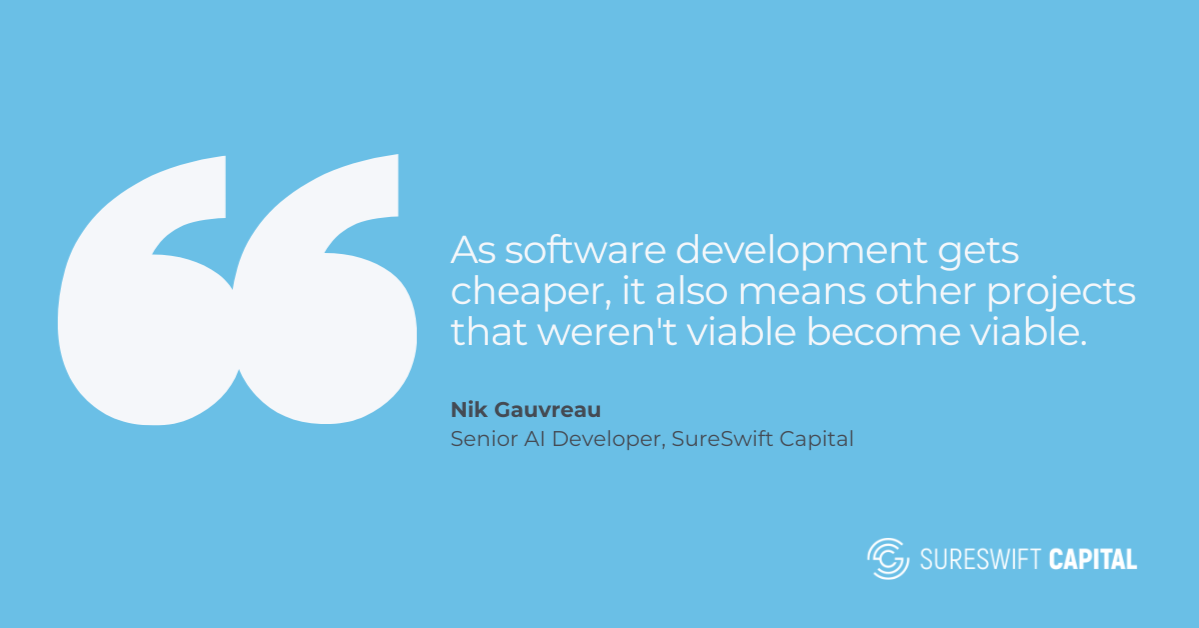
He reaches for a historical comparison to the automobile replacing horse-drawn transportation: an entire economy built around one technology got upended, and many people in that sector were out of work — but what replaced it, from manufacturing to maintenance to infrastructure, ultimately created more jobs than existed before, just different ones.
Still, Gauvreau acknowledges that transition isn't painless. "There will be an awkward period with a lot of transitioning, people moving around, training, doing different things," he predicts.
But his bet is that the people who treat AI as something to work alongside, not around, come out ahead of it. "If people aren't interested in using AI to augment their work, no matter what it is, I think they'll be left behind."
That's the takeaway that matters more than any specific workflow: putting AI agents to work across SureSwift’s portfolio means finding out, business by business, which parts of the work truly need less human time, and which parts still need someone with judgment, context, and the willingness to say "no, that's not right yet" before it ships.

Related articles

OpenClaw, AI Agents, and the Future of SaaS Work
AI agents are starting to move from side experiments into the flow of real work. OpenClaw shows what that shift can look like for SaaS founders and their teams: where agents can help, how to choose the right use cases, and why guardrails matter.

.jpg)
Conversion rate optimization for SaaS: What actually works in 2026 (and beyond)
SaaS conversion rate optimization has moved beyond button tests and landing page tweaks. Here’s how modern teams can improve acquisition, activation, and retention by focusing on user intent, faster time-to-value, and smarter full-funnel decisions.
